Cats have had a wildly inconsistent reputation throughout history. In one era or region, they’re sacred, worshipped, practically royalty. In another, they’re accused of everything from bad luck to full-on witchcraft. Considering how many of us have personally witnessed a cat stare into an empty corner for no reason at 2 AM, it’s honestly not that hard to see how some of these superstitions got started.
Cat superstitions vary enormously by culture, ranging from deep reverence and good-luck symbolism to genuine suspicion and folklore about supernatural powers, often shaped by each region’s specific history with cats. Let’s take a tour around the world and see what different cultures have believed about our favorite chaotic little companions.
Ancient Egypt: Sacred, Protected, and Basically Royalty
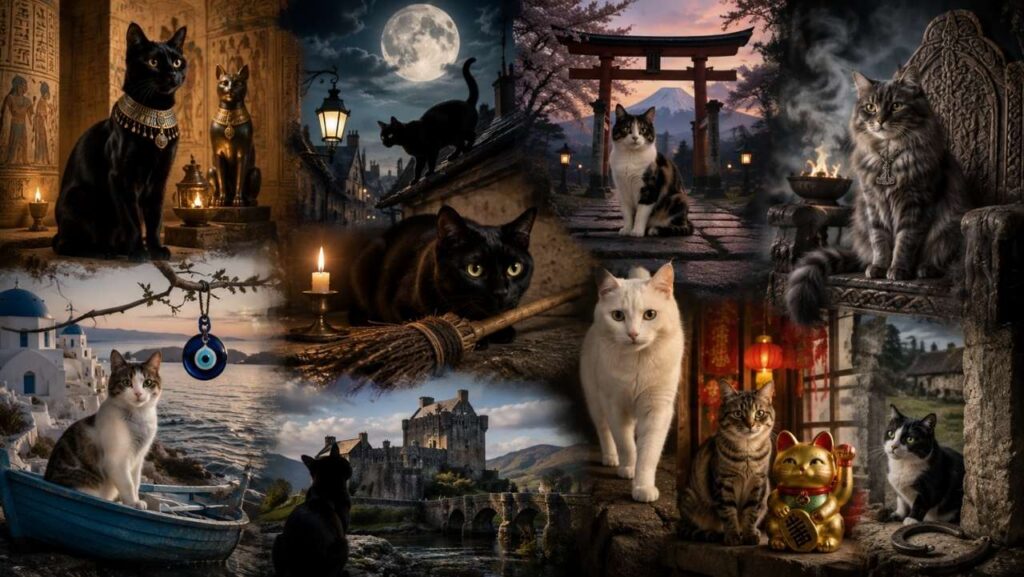
No superstition list is complete without starting here. Ancient Egyptians revered cats to an almost unbelievable degree, associating them with the goddess Bastet, a protector of home and fertility often depicted with a cat’s head. Killing a cat, even accidentally, could carry severe legal consequences, and families sometimes mummified beloved cats to accompany them into the afterlife.
If a house caught fire, legend has it Egyptians would prioritize rescuing the cat first, which honestly tracks — anyone who’s owned a cat has experienced that exact prioritization whether they meant to or not.



Europe: The Black Cat Bad-Luck Legacy
The infamous “black cat crossing your path means bad luck” superstition largely traces back to medieval Europe, where cats, especially black ones, became associated with witchcraft and dark omens. This belief contributed to some genuinely tragic periods in history, including mass killings of cats during plague outbreaks, which, in a twist of grim irony, likely worsened rodent populations and disease spread rather than helping at all.
Interestingly, this superstition isn’t universal even within Europe. In the UK, a black cat crossing your path is often considered good luck, not bad, showing just how much regional variation exists even within a single continent.
Japan: The Beckoning Cat
Anyone who’s visited a Japanese restaurant or shop has likely seen a Maneki-neko, the iconic “beckoning cat” figurine with one paw raised, believed to bring good fortune and prosperity to a business. Legend traces this back to a temple cat whose paw-raising gesture supposedly saved a feudal lord from a lightning strike by beckoning him inside just in time.
Japan also has folklore around the Bakeneko and Nekomata, supernatural cat spirits said to gain magical powers as they age, sometimes even walking on two legs or speaking. It’s less “cute lucky charm” and more “respect your elderly cat, they may or may not develop powers.”
Scotland: The Cat Sìth
Scottish folklore includes the Cat Sìth, a large black cat with a white spot on its chest, said to roam the Highlands. Depending on the version of the legend, it’s either a fairy creature or a witch in disguise, and it was believed that leaving a saucer of milk out on Samhain (a precursor to Halloween) would earn a household good luck, while forgetting to do so might curse the milk supply for the coming year.
Somewhere, a modern cat owner is reading this and thinking, “so basically, my cat already runs this exact protection racket.”


Southeast Asia: Rain-Bringers and Wedding Luck
In parts of Southeast Asia, particularly Indonesia and Malaysia, folklore has linked cats to rainfall, with some traditions involving bathing a cat as a ritual to encourage rain during droughts. In Malaysia specifically, cats have also been considered good luck for newlyweds, with some traditions including a cat as part of wedding ceremonies to symbolize a fertile, fortunate marriage.
China: Guardians Against Evil Spirits
Chinese folklore has generally viewed cats favorably, associating them with protection against evil spirits and even predicting weather changes based on their behavior (a cat washing its face was sometimes taken as a sign that rain was coming). Interestingly, despite this generally positive reputation, the cat is notably absent from the Chinese zodiac’s twelve animals, a fact that’s spawned its own set of folk explanations, including a popular legend that the rat tricked the cat out of a spot during the zodiac’s founding race.
Native American Traditions: Symbols of Independence and Mystery
Various Native American traditions have viewed wildcats and cat-like spirits as symbols of independence, stealth, and intuition, often associated with mystery and a deep connection to instinct. Unlike the more polarized “sacred vs. cursed” narratives found elsewhere, many of these traditions frame cats’ independence as something to be respected rather than feared.




Common Superstitions That Cross Cultures
A few cat-related beliefs show up in slightly different forms across multiple cultures:
- Cats sensing death or danger. Many cultures have some version of the belief that cats can sense impending death, illness, or disaster before humans notice anything. Some of this may stem from genuinely sharp feline senses, cats notice subtle changes in scent, sound, and behavior long before we do.
- Cats and the moon. Various folklore ties cats to lunar cycles, sometimes linking full moons to increased cat activity or “wildness.” Anyone who’s witnessed a cat’s sudden midnight sprint might find this one a little too believable.
- A cat washing its face predicting visitors or weather. Versions of this belief appear in multiple cultures, usually as a lighthearted, low-stakes superstition rather than a serious prediction system.
Why These Beliefs Persist
Cats have always occupied a strange space in human imagination: independent enough to feel a little mysterious, expressive enough to seem almost human, and unpredictable enough that our ancestors filled in the gaps with stories. Add in genuinely striking behaviors, like sensing things we can’t, moving silently, or fixating on something invisible in a dark room, and it’s easy to see why folklore filled in explanations long before behavioral science could.
The Bottom Line
Whether cats have been treated as sacred protectors, unlucky omens, or lucky charms depends almost entirely on where and when you’re standing in history. What stays consistent, though, is how much cats have captured human imagination across virtually every culture on Earth. Your cat, for their part, remains completely unbothered by any of this — sacred deity or supposed bad omen, they’re still going to knock something off the table at 3 AM regardless of what the folklore says.