
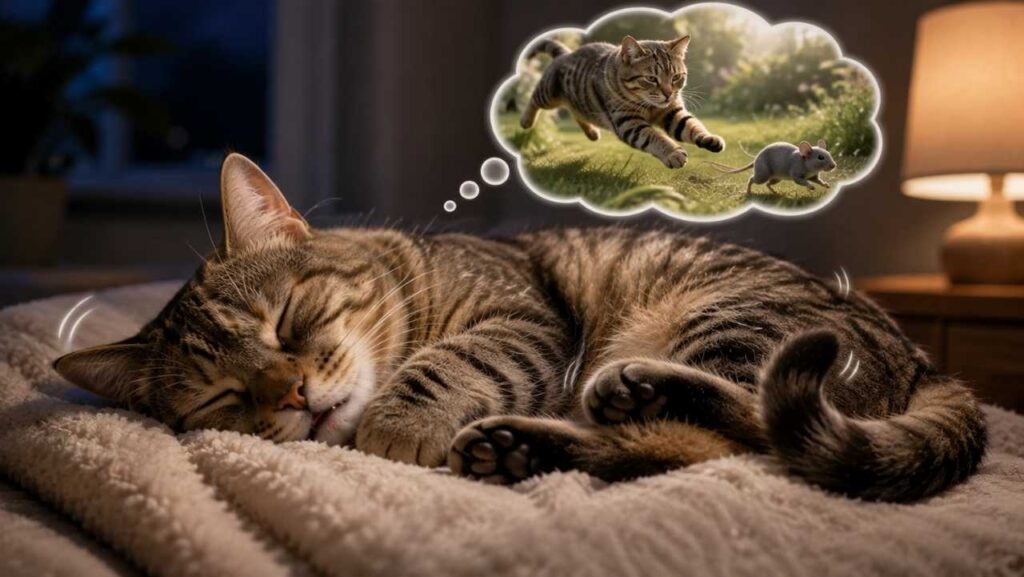
You’re watching your cat nap, minding your own business, when suddenly their paws start twitching, their whiskers flutter, and a tiny, muffled “mrrp” escapes mid-snore. It’s simultaneously the cutest and most mysterious thing your cat does all day, and it raises an obvious question: is your cat actually dreaming, or is this just some kind of involuntary sleep twitch with no story behind it at all?
Cats almost certainly do dream, based on the same sleep-cycle science used to study dreaming in humans, since cats experience REM sleep, the sleep stage most closely associated with vivid dreaming. We can’t ask a cat what they dreamed about, obviously, but the biological evidence points strongly toward real dream activity happening behind those twitching whiskers.
Let’s break down what’s actually happening during your cat’s nap-time performances.
The Science of Cat Sleep Cycles
Like humans, cats cycle through different stages of sleep, including both light sleep and REM (rapid eye movement) sleep. REM sleep is the stage most associated with dreaming in humans, since brain activity during REM closely resembles waking brain activity, even though the body remains mostly still (aside from those telltale twitches).
Cats spend a notable portion of their sleep time in REM specifically, and researchers have observed the same rapid eye movement, muscle twitching, and irregular breathing patterns in cats that show up in humans during dream states. This is a big part of why scientists believe cats experience something dream-like during this stage, even without being able to confirm the actual content of those dreams.
The Famous Cat Study That Started It All
Interest in whether animals dream got a significant boost from research on cats specifically. In a well-known series of experiments, researchers found that cats with a certain area of their brainstem disabled, normally responsible for suppressing movement during REM sleep, began acting out physical behaviors while still asleep: pouncing motions, stalking postures, and other hunting-like movements. This suggested the cats were essentially “performing” whatever was happening in their dream state, since the usual mechanism that keeps the body still during REM wasn’t functioning.
While this specific research involved altered brain function rather than typical sleep, it provided some of the earliest strong evidence that animals, cats included, experience genuine dream content during REM sleep, not just random, meaningless muscle activity.
So What’s Actually Happening With the Twitching?
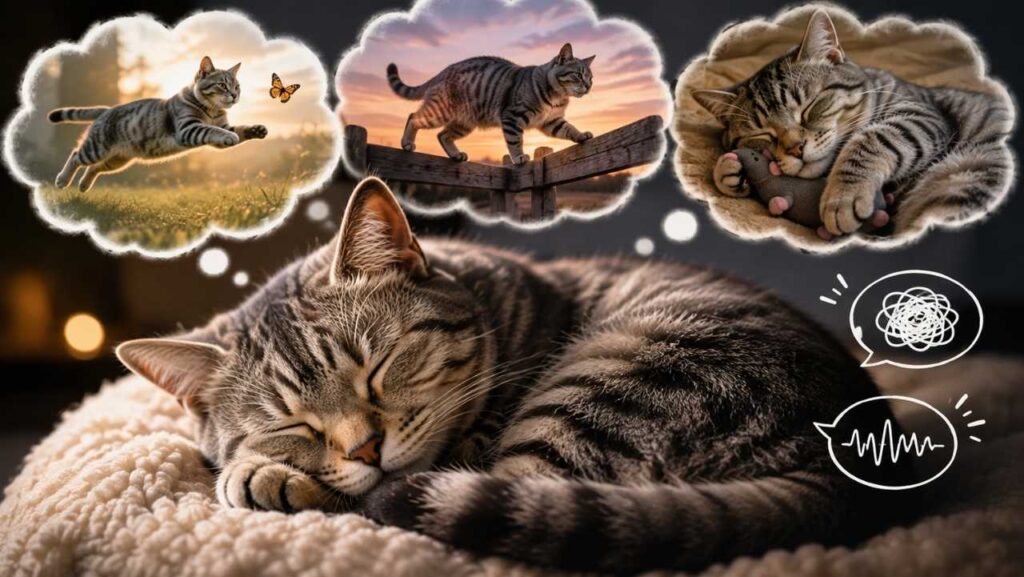
During normal REM sleep, a cat’s brain is highly active, similar to being awake, but a mechanism in the brainstem keeps most voluntary muscles relaxed and still, preventing your cat from fully acting out whatever’s happening in their dream. The twitching you see, paws flexing, whiskers moving, tail flicking, are small breakthroughs of that underlying brain activity, essentially tiny leaks in an otherwise well-contained system.
Those little muffled sounds work the same way: brief vocal breakthroughs from whatever’s happening in the dream state, rather than your cat trying to communicate anything specific to you.


What Might Cats Actually Dream About?
Here’s where hard science gives way to reasonable speculation. Since dreams are generally thought to be shaped by an individual’s waking experiences, memories, and instincts, researchers reasonably assume cats’ dreams likely involve familiar themes: hunting sequences, chasing prey (or a very committed laser pointer), climbing, or other instinct-driven behaviors central to a cat’s daily experience.
It’s a compelling, if unprovable, idea: that twitching paw mid-nap might genuinely be your cat chasing something in their sleep, replaying instinctual behavior their brain considers important enough to revisit even during rest.
Kittens Dream (Or At Least Twitch) Even More
If you’ve ever watched a sleeping kitten and noticed near-constant twitching, that’s not unusual. Kittens spend an even larger proportion of their sleep time in REM compared to adult cats, which lines up with what’s understood about REM sleep supporting brain development and memory processing, particularly important during a stage of life packed with new experiences and rapid learning.



Do Cats Have Nightmares Too?
If dreaming happens, it stands to reason unpleasant dream content could happen too, though this is even harder to study directly than dreaming in general. Occasional signs like sudden vocalization, brief distress-like movement, or a startled wake-up could theoretically reflect something dream-related, but it’s important not to over-interpret normal sleep twitching as a sign of genuine distress. Most sleep-time movement and sound is a completely normal part of the REM cycle, not evidence of a bad dream happening.
Should You Wake a Twitching Cat?
Generally, no, it’s best to let sleeping cats (twitching or not) continue their sleep cycle undisturbed. Interrupting REM sleep isn’t harmful in an emergency sense, but it does disrupt a stage of sleep that plays an important role in memory processing and overall rest. If the twitching is mild and your cat otherwise seems to wake up normally afterward, stretching, alert, behaving as usual, there’s no reason for concern.
The exception is if twitching seems paired with unusual signs like difficulty breathing, prolonged distress after waking, or seizure-like activity (which looks distinctly different from typical sleep twitching, often involving the whole body rather than isolated paw or whisker movement). That combination is worth mentioning to your vet, just to rule out anything beyond normal sleep activity.


Why This Question Is Genuinely Hard to Answer for Certain
The honest limitation here is that we can’t ask a cat to describe their dream afterward, so everything beyond “cats experience REM sleep similar to humans” involves some degree of educated inference rather than direct confirmation. Scientists are confident cats experience something during REM sleep that closely parallels dreaming in humans, but the specific content, the storyline, the “plot” of a cat’s dream, remains genuinely unknowable with current research methods.
The Bottom Line
The next time you catch your cat’s paws twitching mid-nap, whiskers fluttering, a tiny muffled sound slipping out, there’s a good chance you’re witnessing a genuine dream in progress, quite possibly a replay of an epic hunting sequence starring your cat as the undisputed hero. We may never know the exact plot, but the science strongly suggests there’s a story happening behind those closed eyes. Sweet dreams, indeed.