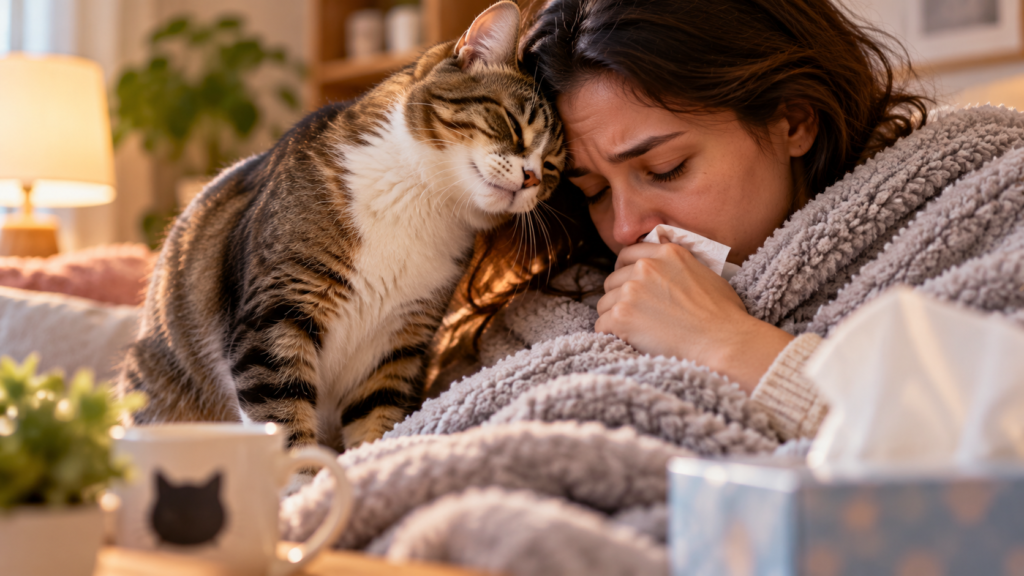
You’re having a rough day. You flop onto the couch, sigh dramatically at the ceiling, and within thirty seconds your cat, who has ignored you since breakfast, appears out of nowhere, climbs onto your chest, and starts kneading your collarbone like she’s been hired for the job. Coincidence? Or does your cat actually know?
Cats can’t read your mind, but they are very good at noticing the changes that come with being sick or sad: shifts in your scent, voice, posture, routine, and energy. Research suggests cats do pick up on human emotional cues, though scientists are still working out how much they understand and why they respond the way they do. In other words, your cat probably isn’t a tiny therapist, but she’s definitely a tiny detective.
What the Research Actually Says
Here’s the honest picture: studies on cats and human emotion are still fairly limited, especially compared with dogs. But what exists is interesting.
Researchers have found that cats can tell their owner’s voice from a stranger’s, and that they respond differently to their owner’s tone. Other studies suggest cats read human facial expressions and body language, particularly the difference between a relaxed, smiling person and a tense or angry one. Some research has also found that cats bond with their owners in ways similar to how infants attach to caregivers, which helps explain why they pay such close attention to us.
What we don’t have is solid proof that cats understand sadness the way a human friend would. What we do have is strong evidence that they notice that something is different, and they react to it.



How Your Cat Probably Picks Up on Your Mood
1. Your Scent Changes
Cats have an incredible sense of smell, roughly fourteen times more sensitive than ours by some estimates. Stress, illness, and strong emotions can all change your body chemistry, including the volatile compounds you give off through skin and breath. You can’t smell the difference, but your cat very well might.
2. Your Body Language Shifts
When you’re sad, you move differently. You slump, move slower, sit still for longer, and curl up. When you’re stressed, you might pace or tense up. Cats are excellent observers of posture and movement, so they notice these changes quickly.
3. Your Voice Sounds Different
Cats are more attuned to your tone than your words. A quiet, flat, or shaky voice sounds different from your usual cheerful “Who’s a good girl?” routine, and cats can tell.
4. Your Routine Falls Apart
Cats are creatures of habit. If you’re sick and suddenly spending the whole day in bed, or sad and skipping your usual morning routine, your cat notices that the schedule has changed. Sometimes what looks like “sensing your illness” is simply your cat noticing that you’re home, horizontal, and warm.


Why Does My Cat Cuddle Me When I’m Unwell?
A few things could be happening, and they’re not mutually exclusive:
- You’re a heat source. Sick people often feel feverish or cold and stay under blankets. Cats love warm, stationary humans. You’ve basically become a very large, very comfortable heating pad.
- You’re calm and still. A resting human is the ideal cat bed.
- Your cat is responding to your emotional state. Some cats may seek you out or stay close when your mood changes, possibly out of attachment or because your behavior has shifted.
- Your cat is comforting herself. When you’re upset, your cat may sense the change in the household atmosphere and look to you for security as well.
The truth is probably a mix. Your cat isn’t necessarily thinking, “I must heal my human,” but she’s responding to the real signals you’re putting out, and her response happens to be warm, purring, and wonderful.
Signs Your Cat Is Responding to Your Mood
Every cat is different, but here are some behaviors owners commonly notice:
- Staying close: following you from room to room or sitting right next to you
- Extra cuddling: climbing onto your lap or chest, especially when you’re lying down
- Purring and kneading: classic comfort behaviors
- Gentle headbutts: a cat’s version of “I’m here”
- Watching you closely: sitting nearby and observing quietly
- Acting differently: some cats get clingier, others get skittish or hide when the household feels tense
That last one matters. Not every cat responds to a sad or sick human with extra snuggles. Some withdraw, get anxious, or act out because the change in the home stresses them. That’s normal, and it doesn’t mean your cat doesn’t care.
What About Cats Detecting Illness?
You’ve probably seen the stories: a cat who obsessively sniffs or sits on one spot of an owner’s body, and later that owner finds out something was wrong. They’re memorable, and they’re fun to share, but it’s worth being careful here.
Cats may notice changes in scent or behavior that come with illness, and there are anecdotal reports of cats paying unusual attention to a part of their owner’s body. But there’s no solid scientific evidence that cats can reliably detect specific medical conditions, and a cat’s behavior should never be treated as a medical diagnosis. If you’re worried about your health, a cat sitting on your stomach is not a substitute for a doctor. (Though she is great at the “stay on the couch and rest” part of recovery.)
What You Can Do With This Knowledge
Understanding that your cat reads your mood can actually help both of you.
- Notice how she reacts to you. If your cat seems more anxious when you’re stressed, taking a few calming breaths or a quiet moment with her can help you both settle.
- Keep her routine steady when you’re having a hard time. Feeding, play, and litter box schedules give her stability when things feel off.
- Let her choose how close to get. If she wants to cuddle, great. If she wants space, respect it.
- Take advantage of the comfort. Petting a purring cat is genuinely relaxing for many people, and many owners find cats a comforting presence on hard days.
- Don’t feel guilty if your cat seems more distant when you’re upset. It doesn’t mean she doesn’t love you; it may just be her way of coping.



The Bottom Line
Your cat can’t diagnose your cold or understand your heartbreak in a human sense, but she’s paying much closer attention than she lets on. She notices your scent, your voice, your posture, and your routine, and when those change, she responds in her own way, whether that’s a purring cuddle, a quiet watch from the end of the bed, or a very smug seat on your chest. Whether that’s “sensing” or just excellent observation, the result is the same: on hard days, there’s often a small, furry creature who decided you shouldn’t be alone. Not bad for an animal that also knocks your water glass off the table for fun.