Your cat locks eyes with you. Slowly raises a paw. Nudges your favorite mug toward the edge of the table. And watches it shatter on the floor like it’s performing a tiny, furry science experiment.
If this sounds familiar, you’re not imagining the eye contact. Cats knock things off surfaces mainly because of leftover predatory instinct, curiosity about how objects behave, and—let’s be honest—because it gets your attention fast. It’s rarely random, and it’s almost never “revenge.” Cats don’t really do revenge. They do “I want something and this works.”
Let’s break down what’s actually going on in that fuzzy little head, and what you can do about it.
It’s Really About Instinct, Not Spite
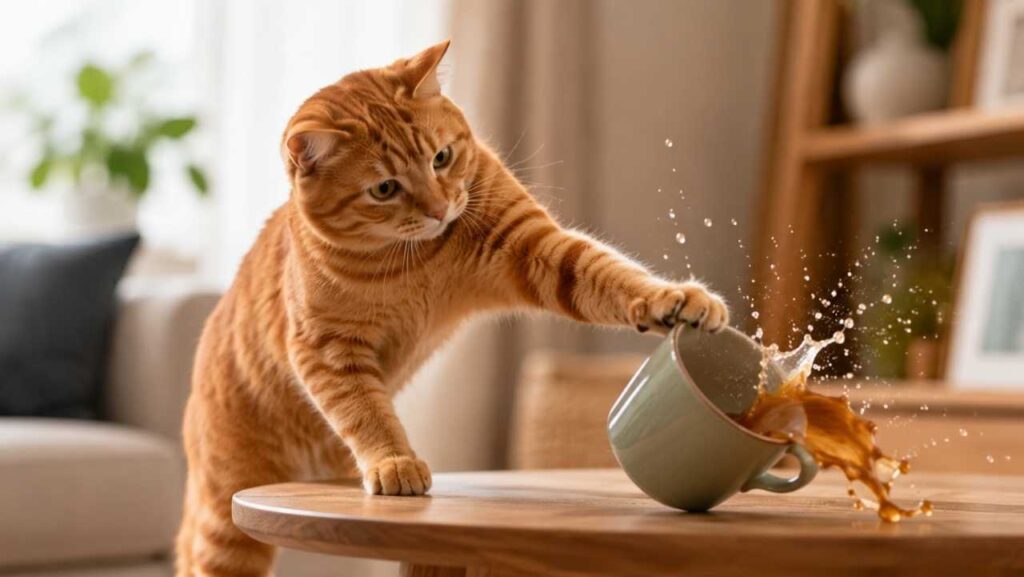
Cats are hunters, even the ones who’ve never seen anything scarier than a vacuum cleaner. In the wild, a lot of hunting involves batting at things—testing whether prey is alive, dead, or about to become dinner. Your pen on the desk? Close enough. That paw-tap-and-watch behavior is a leftover hunting reflex, and it doesn’t go away just because dinner now comes from a can.
Small, lightweight objects that roll or wobble are especially tempting because they move when touched, which mimics the twitch of prey. Your cat isn’t plotting your bankruptcy one wine glass at a time. They’re just running ancient software on modern furniture.
Curiosity Really Did Something to the Cat
Cats are famously curious, and part of how they investigate the world is through their paws. Batting an object off a shelf tells them:
- How heavy is it?
- Does it move?
- What sound does it make?
- Will it come back if I do it again?
That last question is the important one. If knocking something off the counter causes an interesting noise or reaction, your cat has just discovered a fun, repeatable experiment. Congratulations, you’ve accidentally built a science lab.



Sometimes It’s Just… Attention
Cats learn fast. If knocking a pen off your desk gets you to jump up, say their name, and give them eye contact (even annoyed eye contact), they’ve just learned a very effective doorbell. It doesn’t matter if the attention is positive or negative—to a bored cat, “Hey! Stop that!” still counts as “my human is now looking at only me.”
This is especially common if your cat is:
- Under-stimulated during the day
- Left alone for long stretches
- Naturally food— or attention-motivated (looking at you, extroverted cats)
Could It Be Boredom or Excess Energy?
Yes, and this one’s worth taking seriously. A cat with pent-up energy and nothing to chase, climb, or shred will find something to do, and your desk knick-knacks are conveniently located and satisfyingly wobbly. If the knocking happens mostly in the evening or right before mealtime, that’s often a sign your cat has energy to burn and no outlet for it.
Why Some Objects Are More “Victim-Prone” Than Others
Ever notice your cat has favorites? There’s usually a pattern. Small, lightweight items that roll—pens, bottle caps, hair ties—tend to get targeted the most, because they move in unpredictable ways when nudged, which is exactly what makes prey interesting to a hunter’s brain. Anything near an edge is also fair game, since edges are basically an invitation: one paw-tap and gravity does the rest.
Interestingly, cats also seem to zero in on objects that are new. A candle you’ve had on the shelf for two years might be perfectly safe, but the second you bring home a new plant or vase, it becomes suspect number one. New object, new investigation, new potential victim. It’s less “I hate this candle” and more “who is this stranger on my counter, and what happens if I touch it.”
How to Redirect the Behavior (Without Losing Your Mugs)
You don’t need to punish your cat—that mostly just teaches them to knock things over when you’re not looking, which helps nobody. Instead, try redirecting the instinct itself:
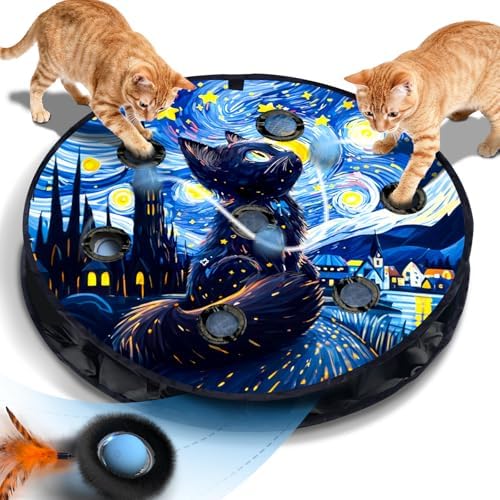
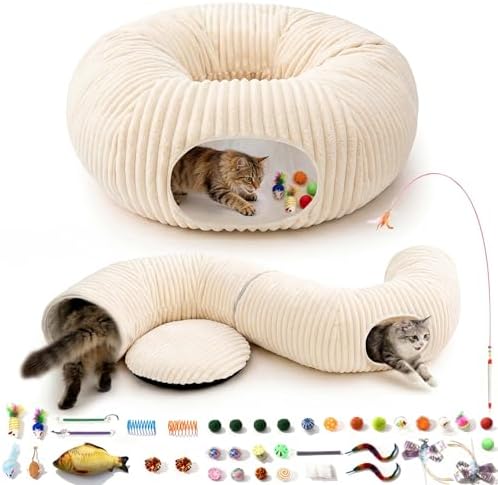
- Give them something better to bat around. Wand toys, puzzle feeders, and rolling ball toys satisfy the same instinct in a way that doesn’t involve your grandmother’s china.
- Add active play sessions, especially before you need quiet time. Ten to fifteen minutes of real chase-and-pounce play can burn off the energy that would otherwise go into “operation knock the pen off the desk.”
- Clear the runway. If your cat has a favorite launch pad (hello, kitchen counter), keep it clear of small, breakable objects. Out of paw, out of mind.
- Don’t reward the behavior with attention. If your cat knocks something over purely for a reaction, try to stay neutral, then reward calm behavior with attention instead. It feels counterintuitive, but consistency wins here.
- Give them a “yes” space. Cats like elevated perches and window views. A cat tree or shelf near a window can satisfy the urge to be up high and alert without your desk becoming ground zero.
- Rotate their toys weekly. Since novelty is a big part of the appeal, a toy that’s been sitting out for a month stops being interesting. Swapping a few toys in and out keeps your cat’s brain engaged with things that are actually meant to be batted around.
![Interactive Cat Toys for Indoor Cats,[Newly Upgraded] Rechargeabl...](https://m.media-amazon.com/images/I/51qR4cw+OyL._AC_.jpg)

When to Pay Closer Attention
Occasional knocking is completely normal cat behavior. But if it’s constant, sudden, or paired with other changes—like increased vocalization, restlessness, or knocking things over at night specifically—it’s worth mentioning to your vet. Increased nighttime activity and attention-seeking can sometimes be linked to things like hyperthyroidism in older cats, so it’s better to rule that out than assume it’s just personality.
The Bottom Line
Your cat isn’t a tiny agent of chaos plotting against your décor—they’re running instincts that used to help their ancestors survive, dressed up as a desk-clearing hobby. The good news is that a bit of play, a few well-placed toys, and some strategically cleared counters can turn “watch this fall in slow motion” into “watch this ball roll across the floor instead.” Your mugs will thank you. Your cat, admittedly, might miss the drama just a little.