
You wake up at 3 AM to the sound of a full sprint down the hallway, followed by your cat confidently leaping onto the exact right spot on the bed without so much as a stumble, in complete darkness. Meanwhile, you can’t find the bathroom without stubbing your toe on something you swear wasn’t there yesterday. It’s tempting to assume your cat has some kind of supernatural night vision, and honestly, the real answer isn’t that far off.
Cats can’t technically see in total, complete darkness, but they can see remarkably well in low light, roughly six to eight times better than humans, thanks to a combination of specialized eye structures built specifically for dim conditions. It’s not magic, but it’s genuinely impressive biology.
Let’s break down how it actually works, and where the “faking it” myth comes from.
The Secret Weapon: The Tapetum Lucidum
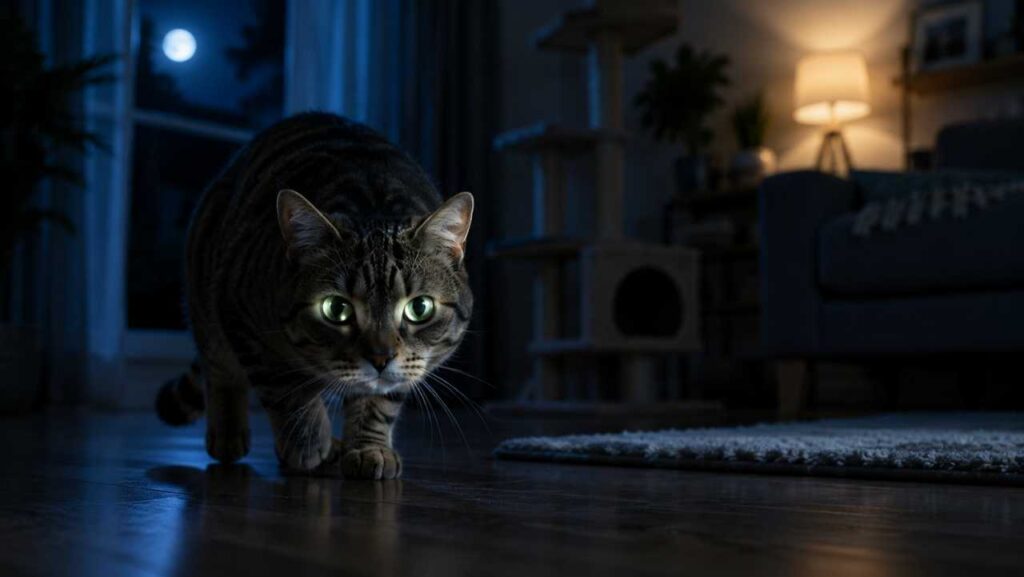
If you’ve ever seen your cat’s eyes glow eerily in a photo or under a flashlight, you’ve already met the tapetum lucidum, a reflective layer located behind the retina. Its job is to bounce light back through the retina a second time, giving light-sensing cells an extra chance to pick up on it. This is also why cat eyes seem to glow in low light, that eerie shine is literally light being reflected back out after making a second pass through the eye.
Humans don’t have this structure at all, which is a big part of why cats have such a significant advantage over us once the lights go down.

![Interactive Cat Toys for Indoor Cats,[Newly Upgraded] Rechargeabl...](https://m.media-amazon.com/images/I/51qR4cw+OyL._AC_.jpg)

More Rods, Fewer Cones
Cat eyes are built with a much higher ratio of rod cells to cone cells compared to human eyes. Rods are the photoreceptors responsible for detecting light and motion, especially in low-light conditions, while cones handle color vision and fine detail in bright light. Cats have far more rods than humans, which is exactly why they excel in dim environments, but also why their color perception and fine detail vision aren’t as sharp as ours in full daylight.
Essentially, cats traded some daytime visual sharpness for a serious low-light advantage, a trade that makes complete sense for a species built to hunt at dawn and dusk.


Bigger Pupils, Bigger Light Intake
Cat pupils can dilate dramatically wider than human pupils relative to eye size, letting significantly more available light into the eye during dim conditions. That’s part of why your cat’s eyes can look almost entirely black in low light, their pupils are wide open, maximizing every bit of available light they can capture.
So… Can They See in Total Darkness?
This is where the “faking it” theory partially holds up. Cats need at least some ambient light to see, even a small amount, moonlight through a window, a hallway nightlight, the faint glow of a router light blinking in the corner. In genuinely total darkness, with zero light whatsoever, cats can’t actually see any better than humans can, which is essentially nothing.
What makes them seem like they’re navigating pure blackness is really a combination of exceptional low-light vision and other finely tuned senses working together, which brings us to the next piece of the puzzle.



It’s Not Just Vision, Whiskers Do a Lot of Work Too
Cats’ whiskers, technically called vibrissae, are packed with sensory receptors that detect subtle changes in air currents and physical contact with nearby objects. In near-total darkness, a cat’s whiskers can help them sense the size and location of nearby obstacles well before they’d ever bump into them, essentially functioning as a supplementary navigation system when vision alone isn’t enough.
Combine that with an exceptional sense of hearing and a strong spatial memory of their environment, and you get a cat that appears to move through darkness with total confidence, even in spaces darker than their eyes alone could actually process.
Why Their Color Vision Isn’t Great
Here’s the flip side of all this incredible low-light ability: cats don’t see color the way humans do. Their color vision is more limited, generally believed to perceive the world in a range of blues and yellows, with limited ability to distinguish reds and greens clearly. So while your cat can spot movement in a dim room far better than you ever could, they’re probably not appreciating the specific shade of that expensive toy you bought them nearly as much as you’d hope.




Why This Matters for Real Life
Understanding cats’ actual night vision capabilities has some genuinely practical uses:
- Total darkness still isn’t ideal. If you’re setting up a space for your cat, a small nightlight or minimal ambient light source can help them navigate more comfortably, especially older cats whose vision may decline somewhat with age.
- Sudden 3 AM chaos makes more sense now. Cats are biologically wired to be highly capable in low light, so those nighttime zoomies aren’t happening despite the dark, they’re often happening because low light is exactly the environment their senses are built for.
- Vision changes in senior cats are worth monitoring. While some decline in night vision is normal with age, sudden clumsiness, bumping into furniture, or hesitance in dim rooms can sometimes signal a vision issue worth mentioning to your vet.
The Bottom Line
Your cat isn’t faking their nighttime confidence, they’ve genuinely got a serious biological advantage in low light, built through millions of years of evolution as dawn-and-dusk hunters. They’re not seeing in pure darkness like some kind of feline night-vision goggles, but between their light-boosting eye structure, wide pupils, and finely tuned whiskers, they’re getting remarkably close. Meanwhile, the rest of us are still stubbing our toes on furniture that’s been in the exact same spot for years. Evolution really did pick a favorite here, and it wasn’t us.