If you live with a cat, you’ve seen it:
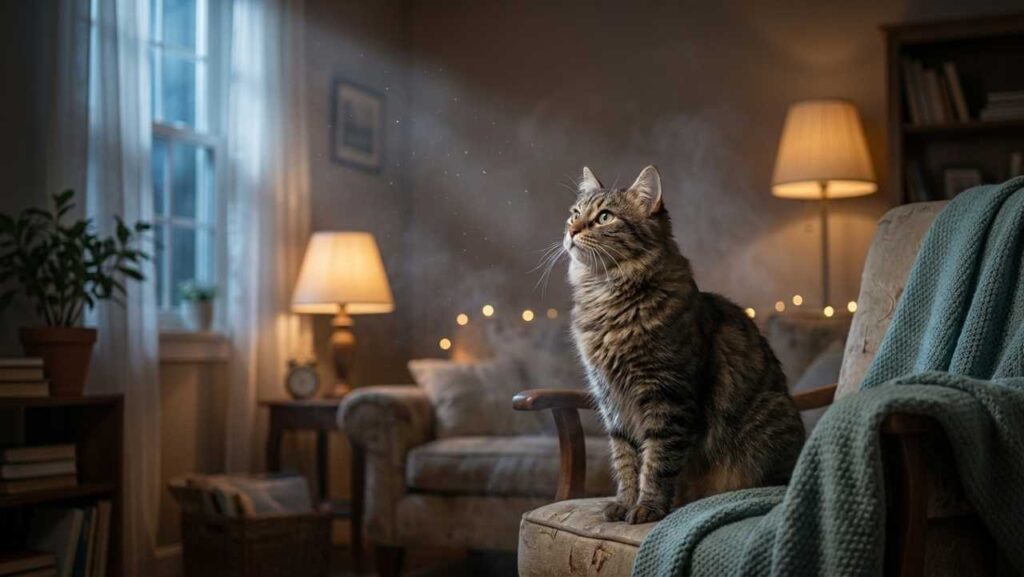
Your cat is peacefully loafing… and then suddenly locks onto something in the corner of the room. Ears forward. Eyes huge. Tail twitching like they just received an urgent message from another dimension.
You look. There’s nothing there.
And that’s when your brain whispers: “Okay. So. Ghosts.”
Before we start blaming the paranormal, let’s talk about what science (and a lot of cat owners) can actually explain. Because cats do have sensory abilities that make them seem like tiny supernatural detectives — and most of the time, the “ghost” is a bug, a sound, a smell, a reflection… or just your cat running the latest update of Cat OS: Weird Edition.
This article will cover:
- why cats stare at nothing (but it’s usually not nothing)
- what cats can sense that humans often can’t
- how to tell “normal cat weird” from “something might be wrong”
- what to do when your cat is acting like your home is haunted
Let’s investigate. Flashlight optional.
Why people think cats see ghosts
Cats have a talent for doing intense, dramatic behaviors with zero explanation. Common “ghost moments” include:
- staring at a wall for minutes
- tracking invisible movement with their eyes
- sprinting down a hallway like they’re being chased
- suddenly refusing to enter a room
- vocalizing at an empty corner
Humans are pattern-seeking creatures. When we see an animal react strongly to something we can’t detect, we naturally fill the gap with a story — and “ghost” is the most entertaining story.
But there’s a more practical explanation:
Cats are built to detect small movements, quiet noises, and subtle changes in their environment.
Which means they’re often reacting to something real… just not visible or obvious to you.


Cat senses: the real “superpower” behind the ghost theory
1) Cats see movement better than we do
Cats are predators. Their vision is designed to spot small, fast movements (think: mice, insects, a shoelace that had the audacity to wiggle).
Even if cats aren’t as sharp at reading fine detail as humans in bright daylight, they’re excellent at:
- noticing tiny motion
- tracking quick movement
- detecting changes in their visual field
So if there’s a little bug on the wall, a shadow shifting, or even a dust particle floating through sunlight, your cat may notice it instantly.
2) Cats hear higher frequencies
Cats can hear sounds far above the range most humans notice. That includes:
- high-pitched electronics
- tiny scratches in walls or ceilings
- rodents or insects moving
- distant noises you’d ignore
If you’ve ever thought your cat was “staring at nothing,” there’s a decent chance your cat was listening.
3) Cats smell more than you think
Cats don’t have dog-level sniffing, but their sense of smell is still far better than ours.
Cats also have a special organ (the vomeronasal organ) that helps them process certain chemical signals. That “open mouth, weird face” reaction (flehmen response) is your cat basically saying:
“This smell is… information.”
So your cat may be reacting to:
- another animal’s scent near your home
- cleaning product residue
- a new piece of furniture smell
- mold/mildew odors
- even changes in your own scent (stress, hormones, new laundry detergent)
4) Cats feel vibrations
Cats are sensitive to vibrations through floors and surfaces. They may pick up:
- footsteps outside
- a neighbor’s washing machine
- plumbing sounds
- heating systems turning on
You might not feel anything. Your cat might feel a whole tiny earthquake.

The most common “ghosts” cats actually see
Here are some very normal, very un-haunted explanations for spooky cat behavior:
1) Bugs (the #1 invisible enemy)
A tiny insect can be hard for humans to spot, especially if:
- it’s small and high up
- it’s on a patterned wall
- your lighting is soft
Cats will track a bug like it’s a major event. Because to a cat, it is.
2) Light reflections and shadows
Common sources include:
- car headlights passing outside
- sunlight reflecting off a watch/phone screen
- TV light flicker
- a ceiling fan shadow
Cats can become obsessed with these — especially cats who don’t get enough play.
3) Sounds inside walls
If your cat stares at a specific wall or ceiling corner, consider:
- rodents
- birds in the attic
- insects
- pipes expanding/contracting
That “haunted corner” might be the location of a very unromantic sound source.
4) Smells you can’t detect
Cats may react to:
- another cat outside (territory tension)
- a new perfume or cleaning product
- a guest’s pet smell
Sometimes the “ghost” is… your neighbor’s cat doing patrol rounds outside.
5) Boredom and predatory instincts
Cats have hunting instincts. If they don’t get enough stimulation, they can:
- create their own entertainment
- hyper-focus on tiny stimuli
- do random sprints (zoomies)
A bored cat is basically a creative director with too much free time.
What science says about cats and “paranormal perception”
Science doesn’t support the idea that cats can detect ghosts (because “ghosts” are not a measurable thing in scientific terms).
But science does support that cats:
- perceive the world differently than humans
- detect small sensory cues (movement, sound, smell) that we miss
- respond strongly to environmental changes
So when owners report cats reacting to “nothing,” the most evidence-based conclusion is:
The cat is reacting to something subtle, not supernatural.
That said, the owner experience is real: it feels spooky because we can’t see what the cat sees.



When “ghost behavior” might actually be a health issue
Sometimes odd behavior is sensory or environmental — but sometimes it’s worth a vet check.
Consider medical causes if the behavior is:
- new and sudden in an older cat
- paired with disorientation, stumbling, or unusual vocalizing
- happening alongside appetite changes, hiding, or litter box changes
- more intense at night, with confusion or restlessness
Possible issues can include:
- vision or hearing changes
- pain (arthritis, dental pain)
- anxiety or cognitive changes in senior cats
- neurological issues (rare, but important to rule out)
Cats don’t always show pain clearly. Sometimes “weird behavior” is the only clue.
Practical ways to respond (without calling an exorcist)
If your cat is acting haunted, try this simple checklist:
Step 1: Look for the obvious triggers
- Any bug activity?
- New light source or reflection?
- New appliance sounds?
- Something moving outside a window?
Pro tip: Get down to cat level. What looks like “nothing” from human height can be very different from 30 cm above the floor.
Step 2: Add enrichment
If the behavior looks like hunting/locking on:
- do 5–10 minutes of interactive play
- use a wand toy and let your cat “catch” something
- offer a puzzle feeder
A lot of “ghost staring” is a cat needing an outlet.
Step 3: Reduce stress in the environment
If your cat seems tense (tail low, ears back, hiding, avoiding rooms):
- keep routines consistent
- provide safe hiding spots
- add vertical space
- consider pheromone diffusers
If there’s a neighborhood cat outside, blocking the view (or adding window film) can help reduce territorial stress.
Step 4: Rule out health concerns
If this is a major change, especially with any other symptoms, check with a vet.
It’s better to be “overcautious cat parent” than to miss a medical issue.


Why cats sometimes act spookier at night
Nighttime amplifies everything:
- your home is quieter, so tiny sounds stand out
- shadows are stronger and stranger
- cats naturally become more active (many are crepuscular: dawn/dusk energy)
So your cat’s 2 a.m. hallway sprint may not be a message from the spirit world.
It may just be:
“The house is quiet. I have decided to be a leopard.”
What owners report (and why it’s still helpful)
Even though science can’t confirm ghosts, owner stories do highlight patterns:
- cats react to environmental changes sooner than humans notice
- cats may become anxious in certain rooms due to noise, scent, or past stress
- cats are highly sensitive to routine disruptions
Owners are often right that something changed — they just may not have detected what it was yet.
So if your cat suddenly hates one room, it’s worth investigating:
- check for drafts (cats dislike cold airflow)
- check for ultrasonic noises (some electronics emit high-pitched sounds)
- check for pests
- check for new scents
Sometimes the “haunting” ends the moment you remove a buzzing charger.
Final take: do cats see ghosts?
Probably not.
But cats do:
- notice tiny movements and shadows
- hear high-frequency sounds
- detect subtle scents
- react strongly to changes in routine or environment
So the next time your cat stares into the void, you have two options:
- assume your home is haunted
- assume there’s a bug, a sound, a scent, or a bored little predator looking for entertainment
Both are valid in spirit.
Either way, your cat will continue acting like a mysterious creature from another realm — which is honestly part of the charm.