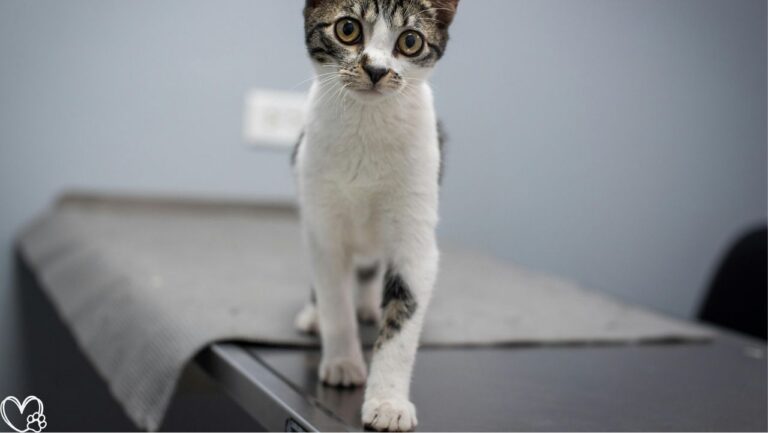
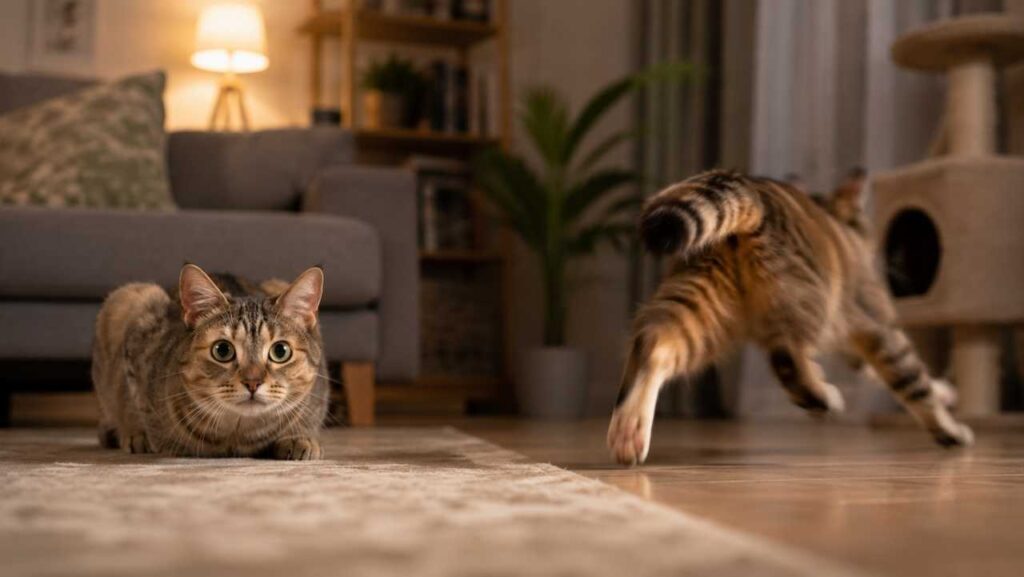
You’re sitting quietly, minding your own business, when you notice your cat locked onto you with that unblinking, slightly unsettling stare. You hold eye contact, wondering if this is finally the moment you two share a deep spiritual connection. Then, without warning, your cat bolts off at full speed like they just remembered an urgent appointment across the house. No transition, no explanation, just full sprint.
This behavior is usually a mix of overstimulation, a burst of built-up energy, or your cat processing something in the environment before deciding, quite suddenly, that being somewhere else is the better option. It looks random, but there’s almost always a reason behind it, even if that reason is “I simply changed my mind about existing in this spot.”
Let’s break down what’s actually happening in that stare-then-sprint sequence.
The Stare Itself Isn’t What You Think
First, let’s clear something up: a cat’s intense stare usually isn’t affection, at least not in the way prolonged human eye contact works. In feline communication, direct, unblinking eye contact can be a form of assessment or even mild challenge, not a warm, loving gaze. Your cat might be evaluating you, watching for movement, or simply processing something about you (a new smell, a change in your posture, the fact that you just moved your foot in a way that looked vaguely like prey).
If your cat is actually relaxed and fond of you, you’ll often see a slow blink mixed in, that lazy, half-closed eye motion cats use to signal trust. A hard, unblinking stare without that softness is more “I am monitoring this situation” than “I love you deeply.”


Then Comes the Overstimulation Threshold
Cats have a genuinely fascinating relationship with stimulation: too little, and they’re bored. Too much, and they hit a sudden threshold where they need to physically remove themselves from the situation. A prolonged stare, especially one involving direct eye contact from a human, can build up a small amount of social tension or excitement that eventually needs an outlet.
That outlet is often a full sprint away from the situation entirely. It’s less “I’m scared of you” and more “that was a lot of intensity, and my nervous system has decided the appropriate response is 100% velocity, 0% explanation.”
Redirected Energy Needs Somewhere to Go
Cats build up physical energy throughout the day, especially indoor cats without a ton of outlets for their natural hunting instincts. A staring session can sometimes be the buildup phase right before that energy needs to release, similar to how a cat might stare intently at a toy right before pouncing. Except in this case, there’s no toy involved, just you, sitting there, unknowingly playing the role of “thing my cat is intensely focused on before their internal alarm goes off.”
The sudden sprint afterward is often just that pent-up energy finally finding an outlet, and you happened to be the staring point right before it happened.


Something in the Environment Might Have Shifted
Cats have exceptional hearing and peripheral awareness, picking up on sounds, movements, or subtle changes long before we notice anything at all. Sometimes that intense stare isn’t actually about you specifically, your cat may be processing a sound in another room, a shadow shifting outside a window, or some other environmental cue that then triggers the sudden sprint.
In these cases, you’re basically an innocent bystander who happened to be in their line of sight when something else entirely caught their attention. It can feel personal, but often it really isn’t.
Could It Be the Infamous “Zoomies”?
If the sudden sprint involves your cat racing through the house, bouncing off furniture, or generally behaving like they’ve been possessed by a small, fast demon, you may be witnessing a classic case of “zoomies,” a sudden burst of hyperactive energy release common in cats of all ages. Zoomies often happen in the evening or early morning, and while the staring beforehand isn’t always directly connected, it can sometimes be an early sign that a burst of energy is building.


Is This Ever a Sign of Something Concerning?
In most cases, this pattern is completely normal cat behavior and nothing to worry about. That said, if the staring seems paired with disorientation, unusual vocalization, stumbling, or seems to be happening in a repetitive, almost trance-like pattern rather than a typical alert stare, it’s worth mentioning to your vet. Occasionally, sudden erratic behavior can be linked to underlying issues like hyperthyroidism or neurological conditions, especially in older cats, so it’s better to rule those out if the pattern feels unusual or is a clear change from your cat’s normal behavior.
For the vast majority of cats doing a completely typical stare-then-sprint routine, though, this is just cats being cats.
How to Respond When It Happens
You don’t need to do much, honestly, but a few things can help if this behavior seems tied to overstimulation or pent-up energy:
- Avoid prolonged direct eye contact if you notice your cat seems tense during a staring session; try a slow blink or looking away instead.
- Provide more physical outlets during the day. Play sessions with wand toys can help burn off the kind of energy that might otherwise build up into random sprinting sessions.
- Don’t chase or follow immediately. Let your cat process whatever’s happening on their own terms rather than adding more stimulation to the mix.
- Keep an eye out for patterns. If it happens at a consistent time of day, that’s a good clue it’s related to natural energy cycles rather than anything concerning.


Why This Behavior Is Actually Kind of Charming, Once You Understand It
Once you know what’s likely going on, the stare-then-sprint combo stops feeling confusing and starts feeling like a little window into your cat’s internal experience: a brief moment of intense focus, followed by an equally intense decision to be somewhere else immediately. It’s not personal rejection, it’s just cats processing the world (and their own energy levels) in their own uniquely dramatic way.
The Bottom Line
That intense stare followed by a sudden, unexplained sprint isn’t your cat rejecting you or plotting something sinister, it’s usually a mix of overstimulation, built-up energy, or your cat simply reacting to something in the environment you didn’t notice. The behavior might look chaotic from the outside, but from your cat’s perspective, it’s a perfectly reasonable response to a perfectly reasonable internal signal. Your job is simply to enjoy the show, and maybe get a good laugh out of the fact that your cat just treated existing in the same room as you like a five-alarm emergency.