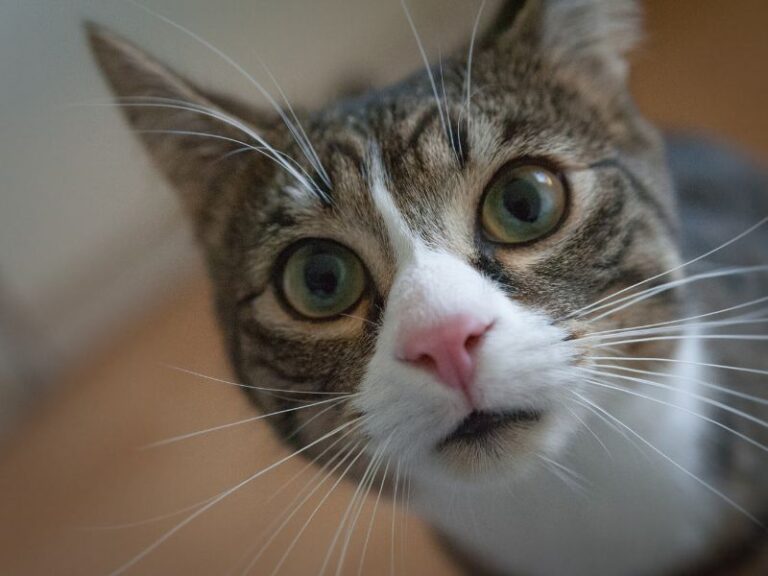
You ask your cat a completely rhetorical question, something like “why did you knock that off the table” or “are you seriously going to sit on my laptop again,” and somehow, they respond. Not with words, obviously, but with a perfectly timed meow, chirp, or that little questioning “mrrp” that makes it feel weirdly like you’re having an actual back-and-forth conversation. It’s uncanny, it’s charming, and it happens far too consistently to be a coincidence.
Cats genuinely do respond to human speech, largely because they’ve learned that vocalizing gets a reaction from you, combined with their ability to recognize your voice, tone, and even the specific patterns of your speech, especially your cat’s own name. It’s not literal conversation, but it’s also not nothing. Let’s break down what’s actually happening.
Cats Learn That Vocalizing Works on Humans
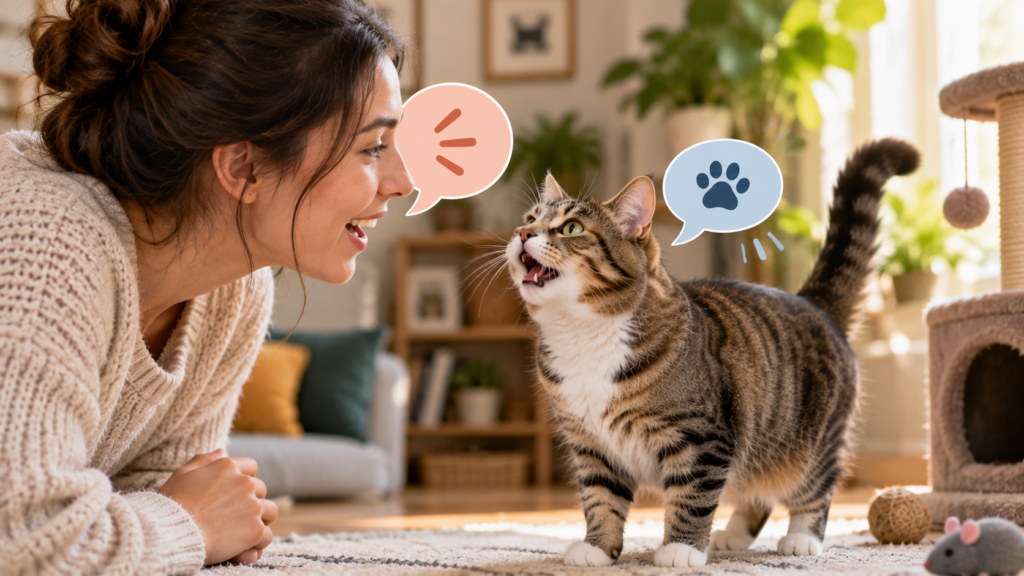
Here’s a genuinely interesting fact: adult cats rarely meow at other cats. Meowing is largely a behavior cats reserve specifically for communicating with humans, developed and reinforced because it gets results. Kittens meow at their mothers, but that behavior typically fades once they mature, unless there’s a human around consistently responding to it.
In other words, your cat has essentially learned, through repeated trial and error, that meowing is an effective way to get your attention, whether that’s for food, affection, or simply acknowledgment. If talking to your cat regularly gets a vocal response back, it’s likely because they’ve learned that responding (in some form) keeps the interaction going, or gets them something they want.


They Recognize Your Voice, and Even Their Name
Research on cat cognition has found that cats can distinguish their owner’s voice from a stranger’s, and can recognize their own name being said, even when it’s mixed in among other similar-sounding words. This doesn’t mean cats understand language the way humans do, but it does mean they’re processing more than people often give them credit for.
So when you say your cat’s name and get an immediate response, that’s not random timing. Your cat has genuinely picked up on the specific sound pattern associated with them, and associates it with your attention being directed their way.
Tone Matters More Than the Actual Words
Cats are remarkably attuned to tone of voice, arguably more than the specific words themselves. A high-pitched, warm, or playful tone tends to prompt more vocal responses, while a flat or neutral tone often gets ignored entirely. This tracks with how cats communicate among themselves too, much of feline communication relies on subtle vocal and body language cues rather than specific “words,” so it makes sense they’d be highly sensitive to the emotional tone of your voice rather than parsing sentence structure.
This is also why baby talk works embarrassingly well on cats. That instinctive high-pitched, sing-song voice most people slip into around pets isn’t silly, it’s actually closer to the tonal range cats respond to most readily.


Timing and Pauses Play a Role Too
Ever notice your cat seems to wait for a pause in your sentence before responding, almost like they’re taking a conversational turn? Some researchers and behaviorists have observed that cats often vocalize during natural pauses in human speech rather than talking over you constantly, which contributes heavily to that “back and forth conversation” feeling. Whether this is a deliberate pattern-recognition skill or simply a byproduct of cats vocalizing whenever they sense your attention has shifted toward them, the effect is the same: it feels remarkably like your cat is actually participating in the conversation.
Individual Cats Vary a Lot in “Chattiness”
Some cats are famously vocal (looking at you, Siamese and other Oriental breeds), narrating their entire day in a steady stream of commentary, while others stay largely silent even when directly spoken to. This variation comes down to a mix of genetics, individual personality, and how consistently a cat has been rewarded (with attention, food, or affection) for vocalizing throughout their life.
If your cat rarely “talks back,” that doesn’t mean they’re not listening or bonded to you, some cats simply express themselves more through body language, purring, or physical closeness than through vocalization.

Is Your Cat Actually Understanding What You’re Saying?
Not in the way a person would, no. Cats aren’t parsing grammar or vocabulary, but they are picking up on patterns: your tone, the specific sound of certain repeated words or phrases (their name, “treat,” the crinkle of a specific bag), and the general emotional context of the interaction. Over time, a cat living with you long-term genuinely builds up a working understanding of certain sounds and their associated outcomes, even without understanding language in any formal sense.
Why It Feels So Genuinely Like a Conversation
Combine voice recognition, name recognition, tone sensitivity, learned vocal responses, and a bit of conversational timing, and you get an interaction that genuinely mimics back-and-forth conversation, even though your cat has no idea what specific words mean. It’s less “understanding English” and more “cats are remarkably good pattern-matchers who’ve figured out exactly which sounds and responses keep their favorite human engaged.”
Honestly, when you break it down, that’s a pretty impressive skill set for an animal we mostly associate with sleeping sixteen hours a day and occasionally sprinting into furniture.



Should You Keep Talking to Your Cat?
Absolutely, and not just because it’s entertaining. Regularly talking to your cat helps reinforce positive associations with your voice and presence, and cats that receive more verbal and social interaction from their owners often show stronger overall bonding behaviors. Whether your cat is genuinely “responding” in a meaningful sense or just reacting to learned patterns, the interaction itself still builds a real relationship over time.
The Bottom Line
Your cat isn’t holding an actual conversation with you, at least not in the way it feels in the moment, but they are genuinely engaging with your voice, tone, and the specific sounds associated with you and your relationship. It’s a mix of learned behavior, sharp pattern recognition, and genuine attentiveness, dressed up as something that looks suspiciously like real dialogue. So go ahead and keep narrating your day to your cat. As far as they’re concerned, you’re clearly saying something worth responding to, even if neither of you can quite explain what.